- Calibration-free stitching = feature-point auto-registration + factory distortion parameters.
- Video stitching needs no on-site calibration; 3D coordinate mapping still does.
1. What On-Site Calibration Means
Traditional video stitching requires on-site calibration: laying a physical calibration board (or walking a reference pattern) through the camera overlap zone so the system can learn the geometry and blend parameters. It is slow, needs a person on site, and must be redone whenever a camera shifts.
The practical question every buyer asks: does this system force me to calibrate on site, or does it work out of the box?
2. Why Traditional Stitching Needed It
To merge two camera feeds into one panorama, the system must know two things: how each lens distorts the image, and how the two cameras are spatially related. Older systems derived both from the calibration board at deployment time — which is why traditional setups are deployment-heavy and fragile.
3. How Calibration-Free Stitching Works
Modern calibration-free stitching replaces the on-site board with two mechanisms:
- Feature-point auto-registration — the algorithm detects matching features in the overlap zone and estimates the transform automatically, with no manual board.
- Factory distortion parameters — each camera model's lens distortion is known in advance and stored per model, so geometric correction is applied automatically.
The result: cameras are mounted, streams are connected, and the panorama is output — no on-site calibration required. This is the SuperMetaX approach, and it is why a 156-channel deployment does not turn into a weeks-long on-site calibration project.
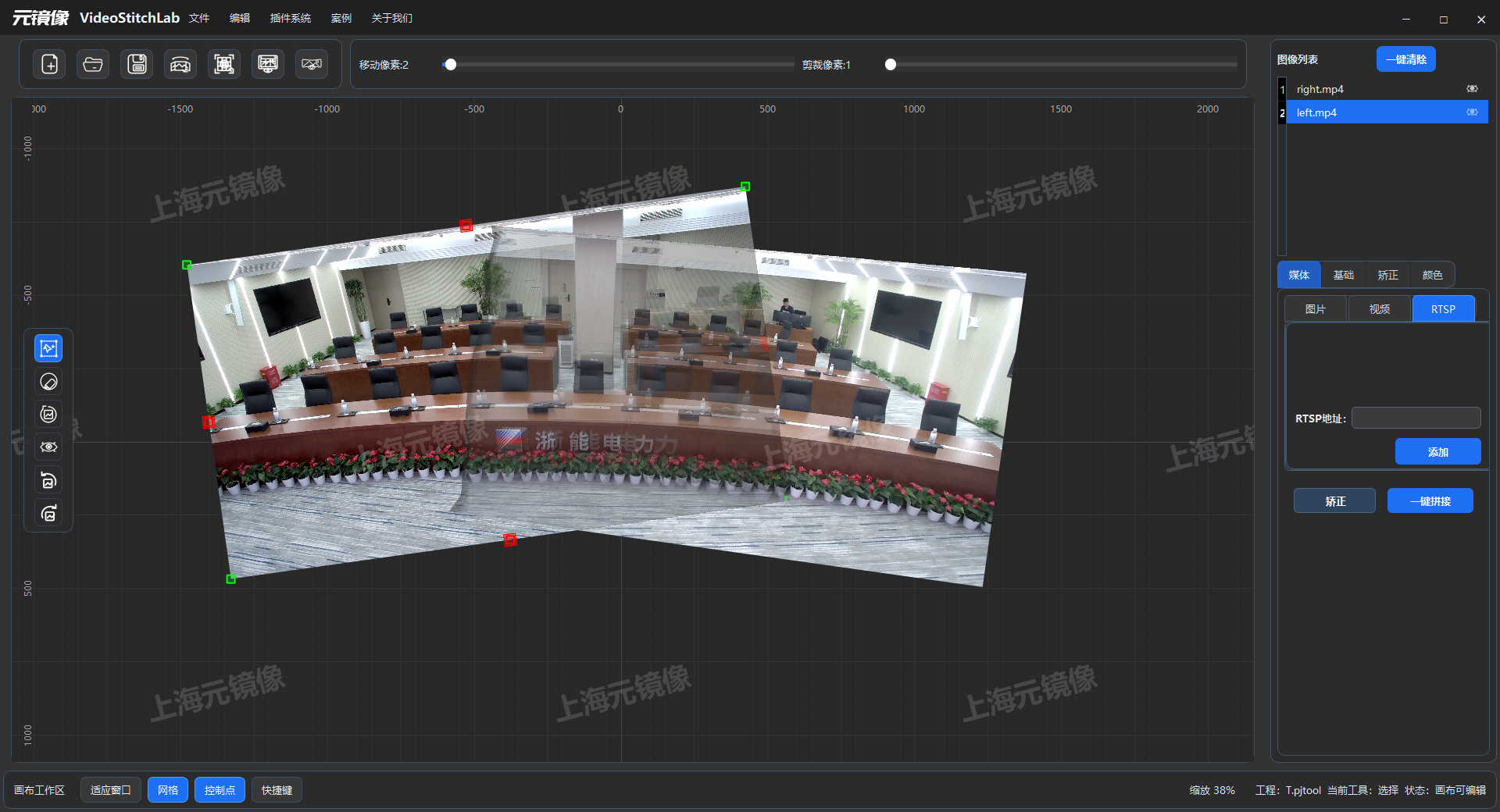
4. One Important Distinction: Stitching vs 3D Mapping
There is a precise boundary you should know. Video stitching needs no on-site calibration (auto-registration plus factory parameters handle it). 3D coordinate mapping for video fusion does require calibration, because mapping a stream onto a 3D model needs the camera's exact pose in space. Do not confuse the two — a vendor who says "no calibration" for stitching is fine; one who says "no calibration" for 3D fusion should be questioned.
5. Why It Matters in Practice
- Faster rollout — no board, no ladder work, no repeat visits after camera drift.
- Retrofit-friendly — existing cameras join without re-surveying the site.
- Lower total cost — deployment time is cut, and future camera adjustments do not require re-calibration.
6. Frequently Asked Questions
Does stitching need a calibration board on site?
No. Mount the cameras, connect the streams, and the panorama is output — no on-site calibration board is required.
What if a camera is bumped later?
Auto-registration re-estimates the transform from the overlapping features, so minor shifts are absorbed without a full re-calibration.
Is 3D video fusion also calibration-free?
No. Video fusion onto a 3D model requires coordinate mapping, which does need calibration for the camera's exact pose. The "no calibration" claim applies to stitching, not 3D mapping.
Does calibration-free stitching work for mixed camera brands?
Yes. Factory distortion parameters are stored per model, so mixed brands can join the same panorama.
Why do some vendors still require on-site calibration?
Older pipelines derive geometry and distortion together on site; calibration-free relies on per-model factory parameters plus feature matching.