- A marine 360° surround view stitches hull cameras into one bird's-eye panorama, eliminating blind spots.
- Selection criteria: channel/camera compatibility, end-to-end latency, signal integration, domestic-environment support.
- End-to-end latency within 200 ms; existing cameras can be reused.
1. What a Marine 360° Surround View System Actually Does
A marine 360° surround view system stitches the feeds from multiple hull-mounted cameras into a single, continuous bird's-eye panorama around the vessel. Unlike a conventional marine CCTV wall of fragmented feeds, it gives the bridge one unified view of the hull perimeter — eliminating the blind spots created by the bow, cargo, and side structures.
| Capability | Conventional CCTV | Marine Surround View |
|---|---|---|
| View | Multiple independent feeds | One stitched 360° bird's-eye view |
| Blind spots | Many, between camera angles | Eliminated by seamless fusion |
| Berthing support | Manual screen switching | Distance lines, angle guides, safety zones overlaid |
| Situational awareness | Cross-referencing screens | Single unified picture for the officer |
The core product line is SeaScope (paired with its Chinese name 船载 360° 环视系统). It targets inland waterways, ports and terminals, and coastal navigation — cargo ships, container vessels, bulk carriers, ferries, tugboats, pilot boats, fishing vessels, and coast-guard ships.
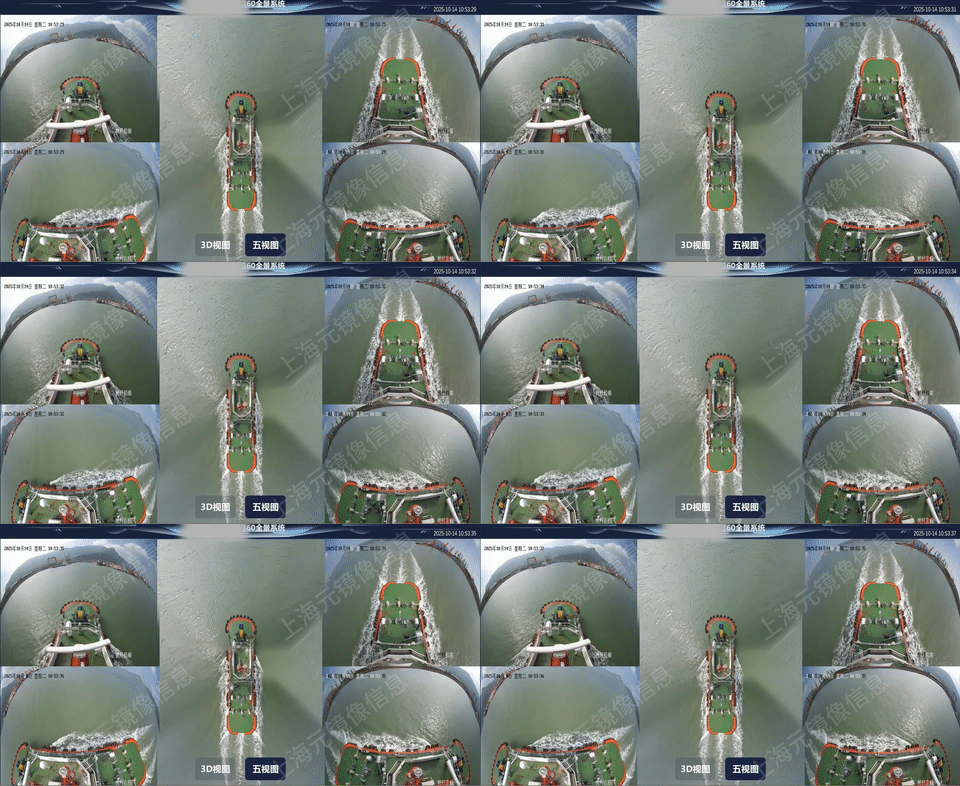
2. Four Selection Criteria That Decide the Outcome
2.1 Channel count and camera-model compatibility
Start by asking how many existing cameras can be reused. A mature system should accept any camera that exposes RTSP, ONVIF or GB28181 standard streams, so you do not need to replace installed hardware. Bullet cameras, PTZ domes, low-light units, and thermal cameras should all join the same panorama.
2.2 End-to-end latency
For ship handling and berthing, latency is the deal-breaker. The SuperMetaX surround view measures end-to-end latency within 200 ms — fast enough for real-time berthing assistance. Latency comes from acquisition, correction, stitching and display, and scales with channel count and output resolution; verify it on the actual vessel before rollout.
2.3 Signal integration (AIS / rudder / RPM)
A surround view is far more useful when it fuses navigation data. Standard interfaces should overlay AIS targets, rudder angle, RPM, wind speed and direction onto the panorama, or feed a 3D console for fused display. Confirm the signal set is configured per vessel type.
2.4 Domestic-environment support
For projects with localization requirements, confirm the system runs on Kylin and other domestic environments. SeaScope supports domestic deployment, which matters for government and state-owned vessel programs.
3. How It Helps with Berthing and Unberthing
The bird's-eye view overlays distance lines, angle guides and safety zones, giving the captain precise, real-time feedback on the vessel's position relative to the quay, bollards and adjacent ships. This replaces distance estimation by eye and verbal coordination — the two highest-risk factors in night, rain, fog and strong-wind operations.
4. Night, Rain and Fog: It Depends on Front-End Selection
Stitching itself does not change image quality; it compensates for single-view limits by combining feeds. For night operation, pair the system with infrared, low-light or thermal cameras. Thermal cameras join the pipeline exactly like visible-light models and appear as ordinary video sources in the panorama. In rain and fog, low-light models with the right mounting height perform best.
5. Typical Scenarios
- Inland waterways — Yangtze and Pearl River vessels, 360° view with AIS overlay for narrow channels.
- Port and terminal — tugboats and pilot boats, berthing assistance, fewer collision accidents.
- Coastal navigation — cargo ships and fishing vessels, all-round awareness with route planning and obstacle alerts.
6. Frequently Asked Questions
Which vessel types is it suitable for?
Cargo ships, container vessels, bulk carriers, ferries and port tugboats — any vessel that needs full-perimeter situational awareness.
Can existing ship cameras be reused?
Mostly yes. Any camera exposing RTSP, ONVIF or GB28181 can join the stitching pipeline, so existing hardware usually stays in place; only new positions need new cabling.
What is the surround-view latency?
End-to-end latency is within 200 ms, meeting the real-time requirement for berthing assistance and ship handling.
Does it integrate with AIS and rudder signals?
Yes — AIS, rudder angle, RPM, wind speed and direction can be overlaid on the panorama or fused into a 3D console.
Does it work at night and in fog?
It depends on front-end selection. Pair the system with infrared, low-light or thermal cameras; thermal cameras join the pipeline exactly like visible-light models.
Does it support domestic environments?
Yes. SeaScope supports Kylin and other domestic environments, which matters for localization and state-owned vessel projects.