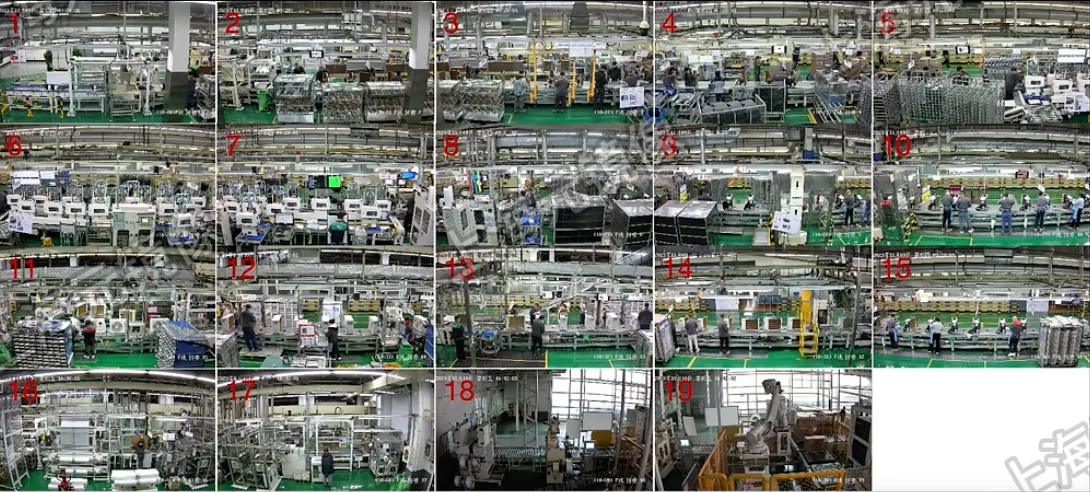
- 19-grid multi-screen becomes one continuous long-strip panorama.
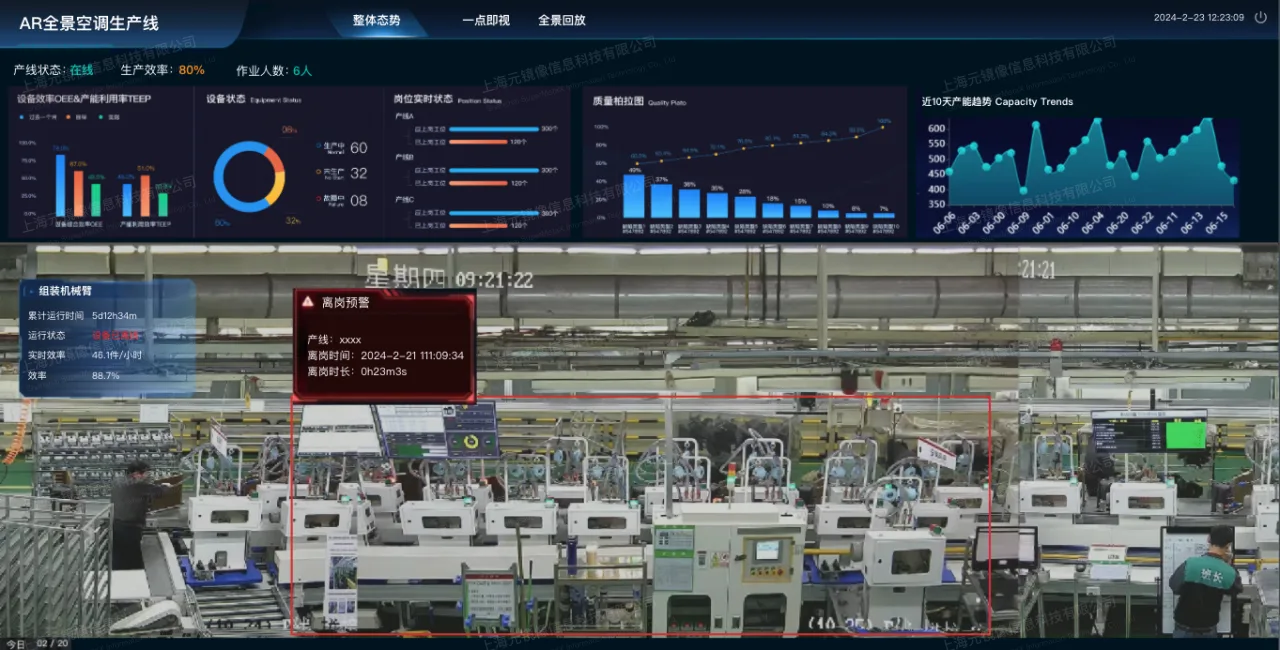
- MES production data is overlaid on the panorama for a live dashboard.
1. The Production-Line Visibility Problem
A long production line is hard to see end to end. Cameras cover each station, but the feeds are separate tiles — a 19-grid wall that forces managers to mentally piece the line together. When a bottleneck or anomaly occurs, locating it across the tiles is slow.
2. The Solution: One Continuous Panorama
Panoramic video stitching merges the line cameras into a single continuous long-strip view. A 145-metre production line can be watched on one continuous image instead of a 19-grid wall. Overlay MES production data — work orders, output, equipment status — and the panorama becomes a live production dashboard, not just video.
3. What It Delivers
| Capability | Result |
|---|---|
| Long-strip panorama | 145m production line on one continuous view |
| MES integration | Work orders, output and equipment status overlaid |
| Multi-screen display | 6-screen video wall for full-line situational awareness |
4. Why It Beats a Grid Wall
A grid wall shows stations; a panorama shows the line. Managers see the whole flow — where work piles up, where a machine is idle, where the line is healthy — on one spatially-correct view. Existing cameras are reused, so a retrofit usually only adds a stitching server.
5. Frequently Asked Questions
Can existing factory cameras be reused?
Yes. Any camera exposing RTSP, ONVIF or GB28181 joins the pipeline, so the existing shop-floor investment stays intact.
How long a production line can be covered?
A 145-metre line is a proven reference case; larger lines scale with channel count up to 156 per server.
Can production data be overlaid on the panorama?
Yes. MES work orders, output and equipment status can be fused onto the panoramic view for a live dashboard.
Do I need to replace the existing VMS?
No. The stitching server taps streams in parallel; the existing VMS keeps its recording, preview and PTZ logic.
Can it display on multiple screens?
Yes. A 6-screen video wall presents the full production line.